



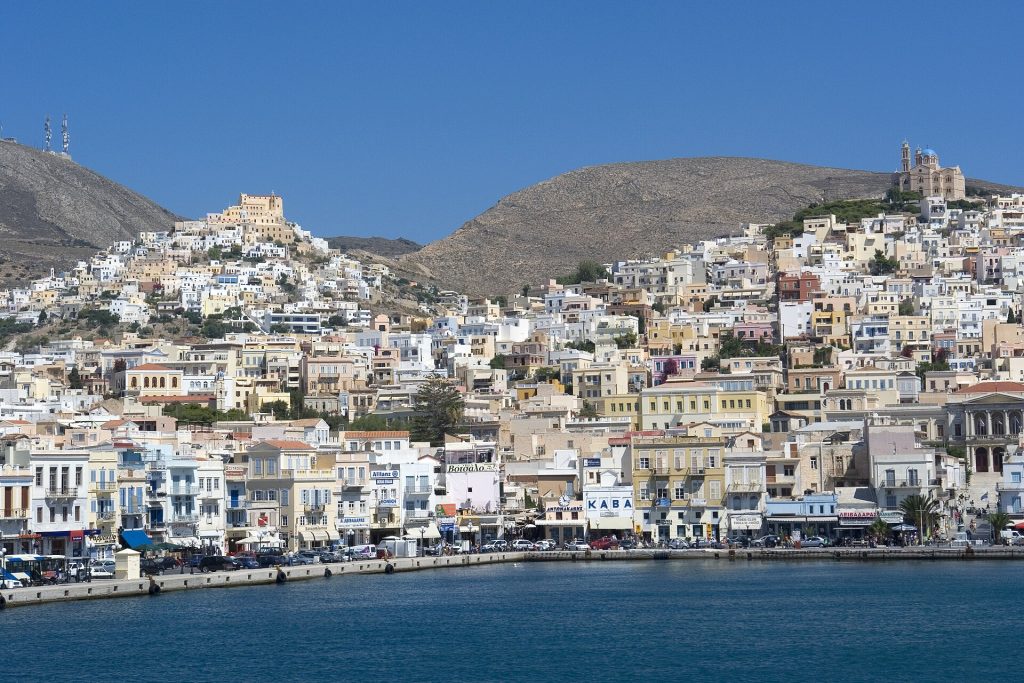
Capital of the Cyclades and for decades the most important commercial and shipbuilding centre in Greece, Syros is different from every other Cycladic island. Instead of the typical white cube-shaped houses, its capital, Ermoupoli, impresses with neoclassical mansions, marble squares and an architectural elegance reminiscent of a little Italy in the Aegean. It is an island where history, religion, architecture and authentic Cycladic life coexist in harmony.
Architectural and Historical Interest: Neoclassical Ermoupoli
Ermoupoli, built in the 19th century by refugees of the Greek Revolution, was the most important port and shipbuilding centre of modern Greece before the rise of Piraeus. This history is visible on every corner of the town: the imposing Town Hall, designed by architect Ernst Ziller on the central Miaouli Square, the historic Apollo Theatre, a miniature of Milan’s La Scala, and dozens of neoclassical mansions preserved in excellent condition.
A walk through the lanes of Ermoupoli, with their marble pavements and historic buildings, offers an architectural experience rare for a Cycladic island. The Industrial Museum of Ermoupoli tells the story of the island’s shipbuilding and industrial tradition, while the Archaeological Museum of Syros displays finds from the Early Cycladic period, showing that the island’s history goes much further back in time.
Religious Interest: Catholics and Orthodox in Harmony
Syros stands out in the Cyclades for its unique religious balance between Orthodox and Catholics, a result of Venetian rule centuries ago. At the top of the hill of the old town, Ano Syros, stands the Catholic Cathedral of St. George, built in the 13th century, with panoramic views over Ermoupoli. On the opposite side, the hill of Vrontado is home to the impressive Orthodox Church of the Resurrection, whose blue domes dominate the landscape.
The Church of the Transfiguration in Ermoupoli and dozens of other churches, Orthodox and Catholic, create a unique religious mosaic that reflects the island’s multicultural history.
Natural Landscape: Villages, Beaches and Traditional Life
Beyond cosmopolitan Ermoupoli, Syros hides authentic Cycladic villages such as Ano Syros, with its narrow, covered medieval-style lanes, and Posidonia (Della Grazia), with its seaside neoclassical mansions. The island has beaches for every preference — from organised ones such as Galissas and Azolimnos to more secluded ones such as Grotta and Lia, ideal for quiet days away from the crowds.
Gentle Tourism and Activities: Hiking and Village Exploration
A network of old paths links the mountain villages of Syros, offering opportunities for hiking with views of the Aegean. Exploring the small inland villages by bike or car, such as Chroussa and Ano Meria, reveals a calmer, rural side of the island, far from the cosmopolitan feel of the capital.
Gastronomy: The Land of Loukoumi and San Michalis Cheese
Syros has a distinctive culinary identity. It is the birthplace of Greek loukoumi (Turkish delight), with traditional workshops in Ermoupoli continuing centuries-old recipes, as well as the sweet halvadopita (nougat pie). The island is also famous for San Michalis cheese, a local graviera-type cheese whose name reflects its Catholic heritage. Tavernas in Ano Syros and Ermoupoli serve authentic Cycladic cuisine, with fresh seafood and local produce starring in every dish.
Why Syros Deserves Your Visit
Syros is the island that proves the Cyclades have many faces. With the neoclassical elegance of Ermoupoli, its unique religious coexistence, authentic villages, quiet beaches and distinctive culinary traditions, Syros offers a more refined, less touristy Cycladic experience well worth discovering.
Photo: Hans Peter Schaefer, http://www.reserv-a-rt.de / Wikimedia Commons, CC BY-SA 3.0 (source)
