



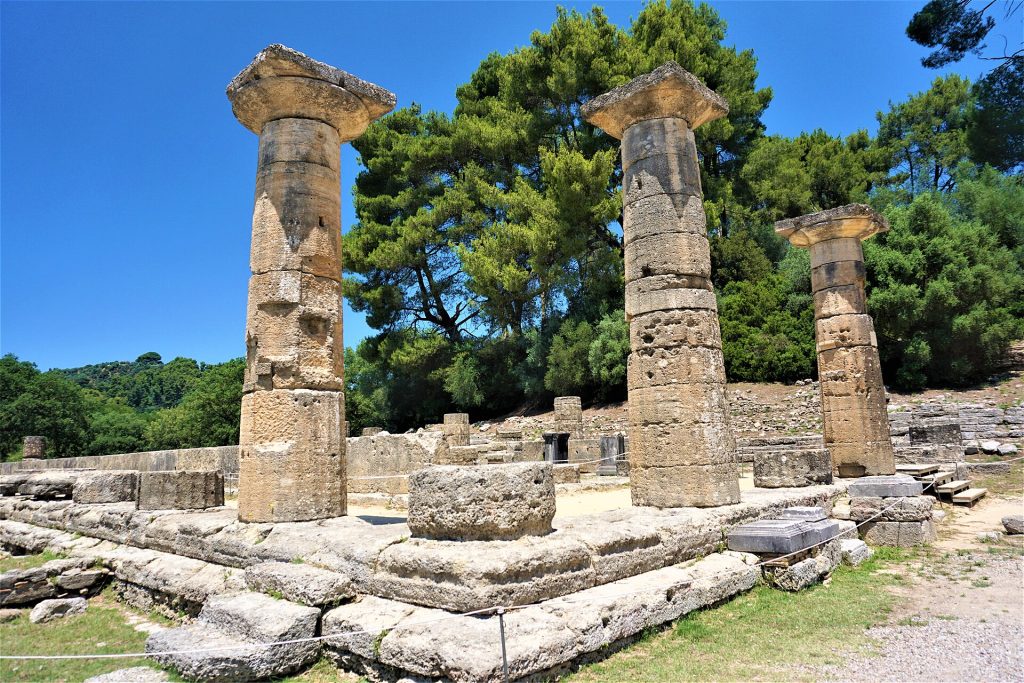
In a lush green valley of the Peloponnese, where the rivers Alfeios and Kladeos meet, lies one of the most sacred and historically important places of the ancient world: Ancient Olympia. Here, for more than a thousand years, the ancient Greeks held the Olympic Games in honour of Zeus, creating an institution that still unites the world every four years. A UNESCO World Heritage Site, Olympia is an iconic destination for every lover of history and sport.
Archaeological Treasure: The Cradle of the Olympic Games
The Archaeological Site of Olympia is unique in the world, combining religious monuments with athletic facilities in grounds shaded by towering pine trees. At the centre of the site lies the Altis, the sacred grove dedicated to Zeus, once dominated by the Temple of Zeus — one of the largest Doric buildings of antiquity, which housed the gold-and-ivory statue of Zeus, one of the Seven Wonders of the Ancient World.
Next to it is the impressively preserved Stadium, with a capacity of 45,000 spectators, where the foot races were held. The site also includes the Gymnasium, the Palaestra where athletes trained, and the Philippeion, an elegant circular building erected by Philip II of Macedon. The Archaeological Museum of Olympia houses remarkable finds, such as the famous Hermes of Praxiteles and the sculptures from the pediments of the Temple of Zeus.
Religious and Spiritual Interest: The Sacred Site of Zeus
Olympia was not just an athletic centre — it was first and foremost a religious sanctuary dedicated to the father of the gods. The Olympic Games were born as a religious ceremony in honour of Zeus, and the sacred truce declared by the ancient cities during the Games is one of the earliest examples of an international peace agreement in human history. A visit to the Altis, the ancient sacred grove, still preserves something of that serene, almost mystical atmosphere.
Outside the archaeological site, small Byzantine churches in the surrounding villages add a more recent religious dimension to the area.
Natural Landscape: A Green Valley Between Two Rivers
Olympia’s location is as impressive as its history. The town lies in a fertile valley surrounded by pine-covered hills, at the confluence of the Alfeios and Kladeos rivers. This natural setting stays cool even in the summer months and creates a peaceful backdrop that enhances the experience of visiting the ancient ruins.
The wider region of Ilia combines green countryside with nearby beaches on the Ionian Sea, ideal for those who want to extend their trip beyond the archaeological site.
Sports Tourism: Olympia’s DNA
Few destinations in the world have such a deep connection with sport as Olympia. Beyond a visit to the historic Stadium, the town is home to the Museum of the History of the Olympic Games in Antiquity and the Museum of the Modern Olympic Games, where visitors can follow the evolution of the Games from antiquity to the present day. The Olympic Flame lighting ceremony, held at the ancient site before every modern Olympics, makes Olympia a point of reference for sports lovers all over the world.
The wider area also offers opportunities for hiking in the surrounding hills and cycling through the picturesque countryside of Ilia.
Gastronomy: Flavours of the Peloponnesian Countryside
The area of Olympia and Ilia is renowned for the quality of its local produce — olive oil, fresh vegetables and fruit from the fertile plains of the Western Peloponnese. Local tavernas serve traditional dishes, homemade pasta and grilled meat, while the area is also known for its wine production, with vineyards spreading across the surrounding hills.
Why Olympia Should Be on Your Travel Itinerary
Ancient Olympia is more than an archaeological site — it is the birthplace of an idea that still unites billions of people every four years. For anyone who wants to feel the roots of the global sporting spirit in a setting of natural beauty and historical awe, a visit to Olympia is a once-in-a-lifetime experience.
Photo: Joyofmuseums / Wikimedia Commons, CC BY-SA 4.0 (source)