



Built on the slopes of Mount Parnassus, overlooking the vast olive-grove valley of Amfissa with the Gulf of Corinth in the distance, Delphi was never just an ordinary place for the ancient Greeks. It was considered the centre of the world — the “Navel of the Earth” — and was home to the most important oracle of antiquity, where kings, generals and ordinary citizens travelled from every corner of the Mediterranean to consult the word of the god. Today a UNESCO World Heritage Site, Delphi offers a combination of history, spirituality and breathtaking natural beauty rarely found elsewhere.
Archaeological Treasure: In the Footsteps of Apollo’s Oracle
The Archaeological Site of Delphi is one of the most impressive in Greece. Climbing the Sacred Way, visitors pass among the ruins of treasuries dedicated by city-states in honour of the god Apollo, reaching the imposing Temple of Apollo, where the Pythia once delivered her famous oracles. A little higher up, the Ancient Theatre is remarkably well preserved, while the Stadium, at the highest point of the site, hosted the Pythian Games — one of the most important athletic and artistic institutions of antiquity.
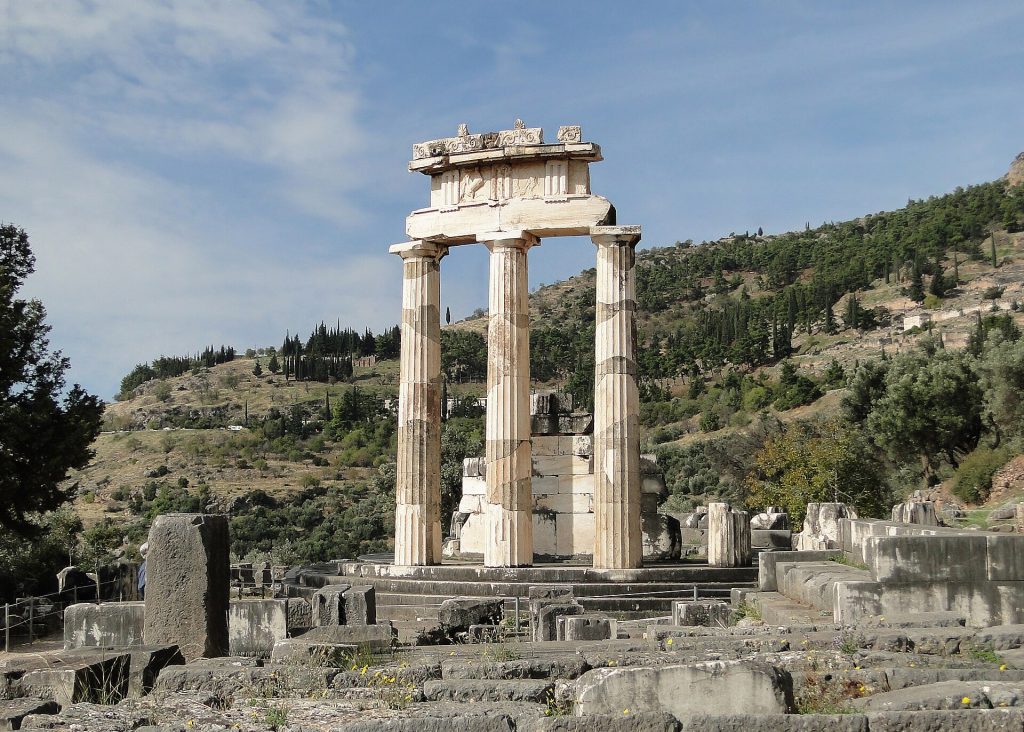
A little further down, the sanctuary of Marmaria includes the striking Tholos, one of the most photographed monuments in Greece, whose circular Corinthian-style columns remain a subject of mystery even to archaeologists. The Archaeological Museum of Delphi houses unique exhibits, such as the famous Charioteer of Delphi, one of the most important bronze statues to survive from the classical era.
Spiritual Dimension: The Sanctuary That United the Ancient World
The religious significance of Delphi surpassed that of any other sanctuary of antiquity. The Pythia, priestess of Apollo, issued oracles that shaped decisions on war, colonisation and politics throughout the Greek world. Visiting the site today still preserves something of that mystical atmosphere — especially in the early morning, before the tour buses arrive, when the mist still embraces the slopes of Parnassus.
Natural Landscape: Between Mountain and Sea
The setting of Delphi is a spectacle in itself. Built at the foot of Parnassus, at an altitude of about 500–600 metres, it offers impressive views over the Amfissa valley, covered by one of the largest olive groves in Europe, with the Gulf of Corinth as a backdrop. Next to the archaeological site, the Castalian Spring — where ancient visitors purified themselves before entering the sanctuary — lies in a gorge of imposing cliffs.
The modern town of Amfissa and the surrounding villages, built amphitheatrically on the slopes, offer endless opportunities for photography and relaxing walks with a view.
Outdoor Activities: Parnassus Calls
Mount Parnassus, sacred in mythology as the home of the Muses, is today a popular destination for mountaineering and hiking, with trails that cross fir forests and lead to panoramic viewpoints. In winter, the Parnassos Ski Centre attracts ski lovers, making the area a rare destination where you can combine ancient history in the morning with winter sports in the afternoon.
Gastronomy: Flavours from the Heart of Phocis
The area is famous for its excellent extra virgin olive oil, thanks to the endless olive groves of the Amfissa valley — considered among the best in Greece. Local tavernas in Delphi and the surrounding villages serve traditional mountain dishes, grilled meat, homemade pasta and local cheeses, often accompanied by wines from the wider region of Central Greece.
Why Delphi Deserves Your Visit
Delphi is not just an archaeological site — it is a journey into the heart of ancient Greek thought, where mythology, religion and politics meet in one of the most spectacular natural settings in the country. For anyone who truly wants to understand the ancient Greek world, a visit to Delphi is an absolute must.
Photo: Bernard Gagnon / Wikimedia Commons, CC BY-SA 4.0 (source)